When They Blew the Levee
Race, Politics, and Community in Pinhook, Missouri
 Buy the Book:
Amazon
Bookshop.org
Published by: University Press of Mississippi
Contributors: David Todd Lawerence
Release Date: June 4, 2018
Pages: 224
ISBN13: 978-1496817730
Overview
Winner of the 2019 Chicago Folklore Prize
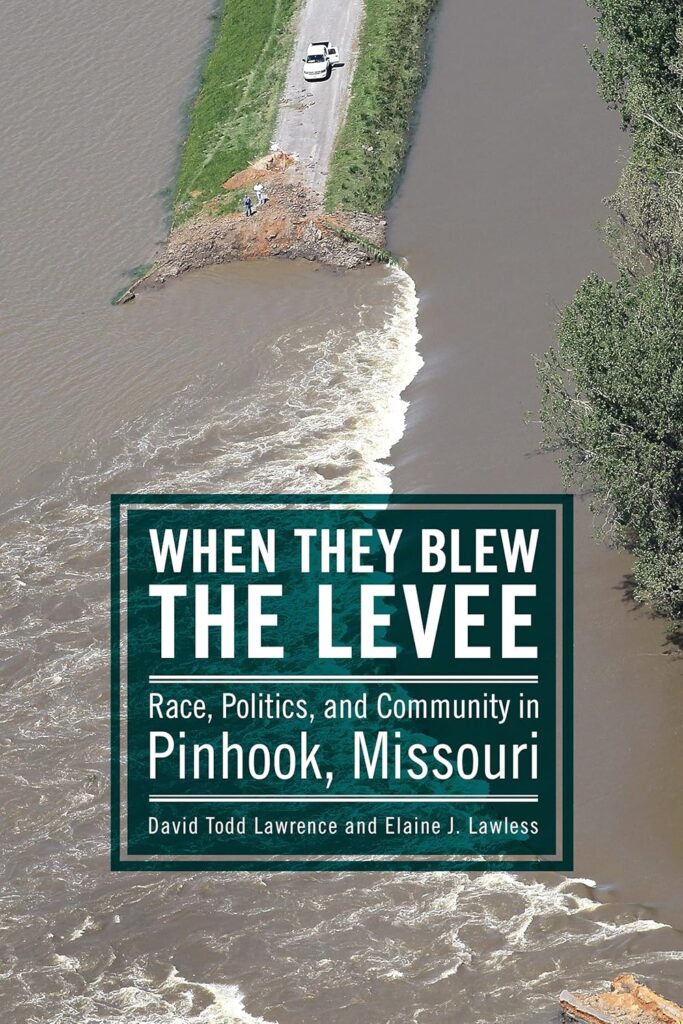
In 2011, the Midwest suffered devastating floods. Due to the flooding, the US Army Corps of Engineers activated the Birds Point-New Madrid Floodway, one of the flood prevention mechanisms of the Mississippi Rivers and Tributaries Project. This levee breach was intended to divert water in order to save the town of Cairo, Illinois, but in the process, it completely destroyed the small African American town of Pinhook, Missouri.
 In When They Blew the Levee: Race, Politics, and Community in Pinhook, Missouri, authors David Todd Lawrence and Elaine J. Lawless examine two conflicting narratives about the flood--one promoted by the Corps of Engineers that boasts the success of the levee breach and the flood diversion, and the other gleaned from displaced Pinhook residents, who, in oral narratives, tell a different story of neglect and indifference on the part of government officials. Receiving inadequate warning and no evacuation assistance during the breach, residents lost everything. Still after more than six years, displaced Pinhook residents have yet to receive restitution and funding for relocation and reconstruction of their town. The authors' research traces a long history of discrimination and neglect of the rights of the Pinhook community, beginning with their migration from the Deep South to southeast Missouri, through purchasing and farming the land, and up to the Birds Point levee breach nearly eighty years later. The residents' stories relate what it has been like to be dispersed in other small towns, living with relatives and friends while trying to negotiate the bureaucracy surrounding Federal Emergency Management Agency and State Emergency Management Agency assistance programs.
Ultimately, the stories of displaced citizens of Pinhook reveal a strong African American community, whose bonds were developed over time and through shared traditions, a community persisting despite extremely difficult circumstances.
Praise
"[This book] brings a rich, acute awareness of how the collection of oral (counter) narratives might induce social change. Without their meticulous work this town’s despair and resilience would remain untold.”
— Jerrilyn McGregory, author of Downhome Gospel: African American Spiritual Activism in Wiregrass Country
"Lawless and Lawrence recount the stories of loss and solidarity from African American men and women who called this corner of the Bootheel region of Missouri home. By writing this book, they have amplified the voices of individuals whose stories should be heard and whose losses should be mitigated."
—Patricia A. Turner, professor of African American studies, UCLA